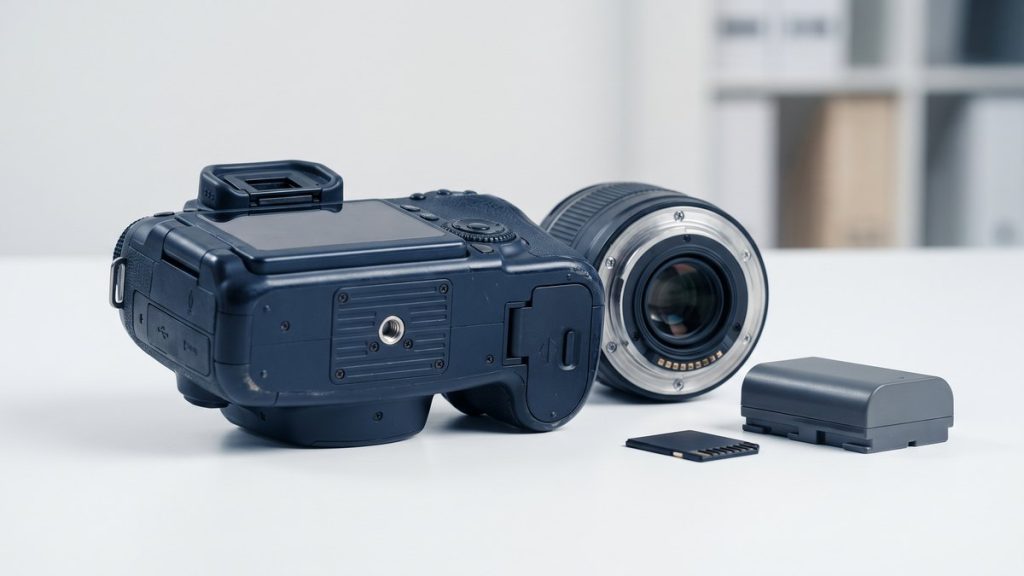
What counts as WEEE when you recycle a camera?
All cameras — DSLRs, mirrorless bodies, compact cameras, film scanners, and digital camcorders — are classified as Waste Electrical and Electronic Equipment (WEEE) under the WEEE Regulations 2013. That means you cannot legally dispose of them in general commercial or household waste.
WEEE regulations exist to prevent hazardous materials — including lithium-ion battery cells, circuit board chemicals, and certain optical coatings — from entering landfill. If you are a business disposing of cameras on behalf of your organisation, you carry an additional duty of care under the Environmental Protection Act 1990 to ensure they go to an authorised treatment facility.
What data is stored on a camera, and does it matter?
This is a question many people overlook. Modern cameras store data in more places than most users realise:
- Memory cards (SD, CFast, XQD, CF cards) — these hold image and video files and must be formatted or wiped before disposal
- Internal storage — some compact cameras and camcorders have built-in flash memory
- Wi-Fi credentials — cameras with wireless connectivity store network passwords
- GPS data — location-tagging information embedded in image metadata
- Custom settings and profiles — less sensitive, but can include personal naming conventions or client references
For businesses, failure to remove personal or client data before disposal could constitute a breach of UK GDPR / Data Protection Act 2018. The ICO expects organisations to implement appropriate technical measures when decommissioning equipment that has processed personal data. Our guide on how to wipe data from a camera before selling walks through each step in plain language.
How to recycle a DSLR camera
DSLR bodies are relatively straightforward to recycle. Before you hand them over:
- Remove and securely wipe or destroy all memory cards
- Perform a factory reset via the camera menu to clear Wi-Fi credentials and internal settings
- Remove the battery (lithium-ion batteries must be recycled separately under battery regulations)
- Include any lens caps, straps, and chargers if you want to keep the set together
If the camera is still functional, consider whether donation is a better option than recycling — working DSLRs can go to community photography projects, schools, and charities that cannot afford new equipment.
How to recycle a mirrorless camera
Mirrorless bodies follow the same process as DSLRs. One additional consideration: many mirrorless systems use proprietary memory card formats (CFexpress Type A, XQD) that require specific card readers to wipe. If you cannot wipe the card, physical destruction of the card is an acceptable alternative for businesses with a data security obligation. Our secure data destruction service covers removable media as well as drives.
How to recycle compact cameras and camcorders
Compact cameras and camcorders often have more internal storage than DSLR or mirrorless bodies. Check the camera’s settings menu for a “format internal memory” or “reset all” option. For camcorders with mini-DV tape, remove and retain or destroy tapes separately — tape is not covered by camera WEEE recycling routes.
Recycle4Charity’s free business camera collection
Recycle4Charity collects camera equipment from businesses across London and the South East at no charge. Equipment that is still functional is refurbished and given free to digitally-excluded Londoners — community groups, schools, refugee programmes, and individuals who cannot access technology. Equipment beyond economic repair is processed through a certified authorised treatment facility (ATF), and you receive a waste transfer note as evidence of compliant disposal.
We handle complete studio and production setups as well as individual items. If you have a larger clearance — including lenses, lighting, tripods, and AV equipment — our team on the AV and camera equipment recycling page can arrange a single collection covering everything.
What happens to cameras after recycling?
At a certified ATF, cameras are dismantled by category. Metals (aluminium body shells, copper wiring, steel components) are separated and sent to smelters. Plastics are sorted by polymer type for mechanical recycling where possible. Optical glass from fixed lenses is processed separately. Lithium-ion cells go through a dedicated battery recycling stream.
Nothing goes to landfill. You receive a certificate of recycling on request.
Can I put a camera in a council recycling bin?
Householders can take cameras to most local authority household waste recycling centres (HWRCs), where they should go in the WEEE skip rather than general recycling. Businesses cannot use HWRCs — they must use a commercial WEEE collector.
If you are unsure whether your organisation qualifies as a business producer of WEEE, the Environment Agency’s guidance on WEEE regulations offers a straightforward check.
To arrange a free business collection or find out what happens to donated equipment, contact the Recycle4Charity team.