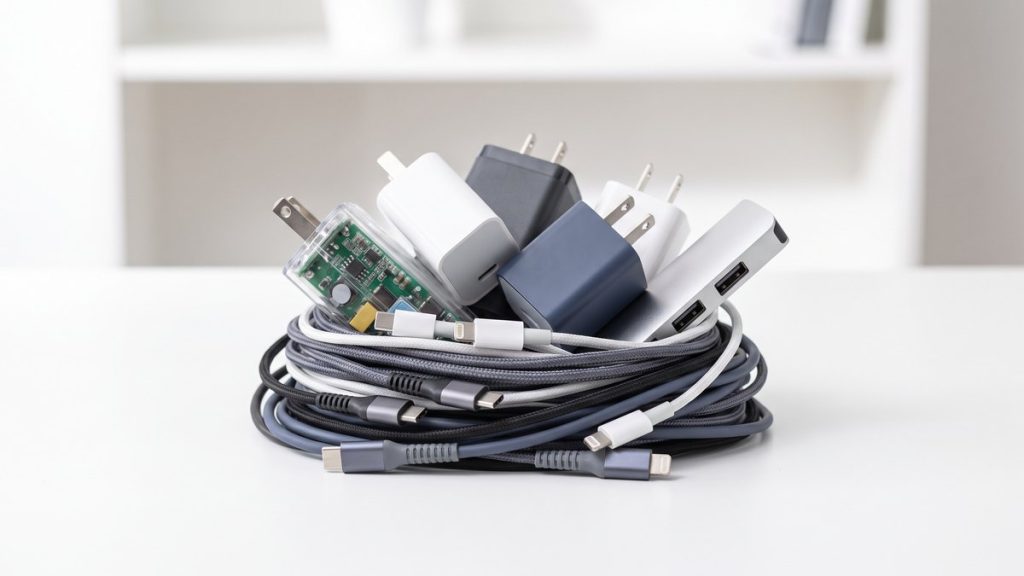
Why cables and chargers cannot go in the bin
It is easy to assume that a USB cable or phone charger is too simple to matter for waste regulations. In practice, every cable and charger is classified as WEEE because it is an electrical item that has reached the end of its useful life.
The environmental case is equally clear. Cables contain copper conductors, aluminium shielding, and PVC or cross-linked polyethylene insulation. When these materials reach licensed recycling facilities, the copper is recovered and returned to the supply chain — reducing the need for primary copper mining, which is energy-intensive and damaging to ecosystems. When cables enter landfill, insulation degrades and copper may leach into groundwater.
What types of cables and chargers are covered?
The following are all WEEE and should not go in general waste:
- Mains power cables and extension leads
- USB cables (USB-A, USB-C, Micro-USB, Lightning)
- Phone chargers and wireless charging pads
- Laptop power adapters and docking station cables
- Monitor cables (HDMI, DisplayPort, VGA, DVI)
- Network cables (Ethernet, coaxial)
- Audio and video cables (3.5mm jack, RCA, optical)
- Keyboard and mouse cables
- Printer and scanner USB/parallel cables
Essentially: if it has a plug, a connector, or runs an electrical signal, it is WEEE.
Do cables hold personal data?
Standard cables and power adapters do not store data. However, some smart charging cables marketed as containing chips that negotiate fast-charging protocols may have minimal embedded firmware. For standard office and consumer cables, data security is not a concern.
For smart USB hubs, docking stations with integrated storage, or KVM switches with memory — check the manufacturer specification before disposal. If in doubt, treat them as data-bearing devices.
Options for recycling cables and chargers
Through a certified WEEE recycler
For businesses, this is the appropriate route. A certified ITAD or WEEE recycler will collect cables and chargers alongside other end-of-life equipment, issue a Waste Transfer Note, and process materials through licensed streams. Recycle4Charity’s WEEE recycling service for London businesses accepts mixed loads including cables.
At a council Household Waste Recycling Centre (HWRC)
London residents can drop cables and chargers at their local HWRC free of charge. HWRCs accept WEEE including small items such as cables. Check your borough council’s website for your nearest site and opening hours.
Electrical retailer take-back
Under the WEEE Regulations, retailers selling electrical goods must accept like-for-like returns of old equipment. This technically covers cables and chargers. In practice, most large electrical retailers (including those operating under producer compliance schemes) accept small WEEE items at customer service desks or designated collection points.
Manufacturer and brand take-back schemes
Some manufacturers operate take-back programmes specifically for accessories including cables. Apple, for example, accepts Apple-branded accessories at its retail stores. Check your device manufacturer’s environmental page for details.
What happens when cables are recycled?
Licensed WEEE recyclers process cables through a granulation and separation process:
- Cables are shredded into small fragments.
- The fragments are passed through separation equipment — typically using air classification or eddy-current separation — that separates copper and aluminium from plastic insulation.
- Metal fractions are baled and sent to smelters for refining.
- Plastic fractions are processed for secondary plastics use or energy recovery, depending on the plastic type and contamination level.
Copper recovered from cable recycling is a high-quality secondary material. It re-enters the manufacturing supply chain, reducing the demand for primary copper from mines.
Comparison of recycling routes for cables and chargers
| Route | Cost | Suitable for businesses? | Bulk volumes | Documentation |
|---|---|---|---|---|
| Certified WEEE recycler | Often free for bulk | Yes | Yes | Waste Transfer Note issued |
| Council HWRC | Free | No (household only) | No | None |
| Electrical retailer | Free | No | Small quantities only | None |
| Kerbside recycling bin | N/A — illegal | No | No | None |
Tips for collecting cables before disposal
Cables accumulate quickly in office environments. Before arranging a collection:
- Bundle cables by type and tie loosely — do not use tight cable ties that make separation difficult for recyclers.
- Separate cables that still have usable life (consider donating working chargers to reuse schemes before they reach end of life).
- Include power adapters and docking stations in the same collection to avoid multiple separate arrangements.
- Do not mix cables with general rubbish — even a single bin bag containing cables and general waste is technically non-compliant.
Cables disposed of alongside IT equipment
If you are decommissioning computers, monitors, or other hardware, cables are often the last category to be addressed. Including cables in the same ITAD collection as the main hardware reduces administrative overhead. When you book an ITAD collection with Recycle4Charity, let the team know you have cables to include — they can be added to the same Waste Transfer Note.
For a complete overview of business IT disposal — including computers, servers, and peripherals — see our WEEE recycling page for London businesses.
Ready to recycle your cables and chargers?
Recycle4Charity collects cables and mixed WEEE from London businesses, with full WEEE compliance documentation. Contact us via our WEEE recycling page to arrange a collection.