

Recycle4Charity technician with business laptops, a server unit and hard drives ready for secure collection
Tech-for-good · London

Circular vs Linear Economy: What Is the Difference?

A linear economy follows a straight line: extract, make, use, discard. A circular economy closes that line into a loop: products and materials are kept in use, repaired, reused, and recovered rather than thrown away. The difference matters enormously for how businesses manage IT equipment.

Business tech → someone's new start

Certified data destruction
WEEE-registered
Fully insured
Proudly London

One problem on each side. One simple loop.

The UK throws away around 1.65 million tonnes of electronic waste a year — the fastest-growing waste stream. At the same time, up to 19 million adults live in digital poverty, without the device they need to work, learn or stay connected.

So we take the tech your business has finished with and put it back to work. Every device is collected, wiped to certified standards and refurbished — then given free to a Londoner who needs one. Nothing usable is thrown away, and nothing is sold for profit.

Book a free collection
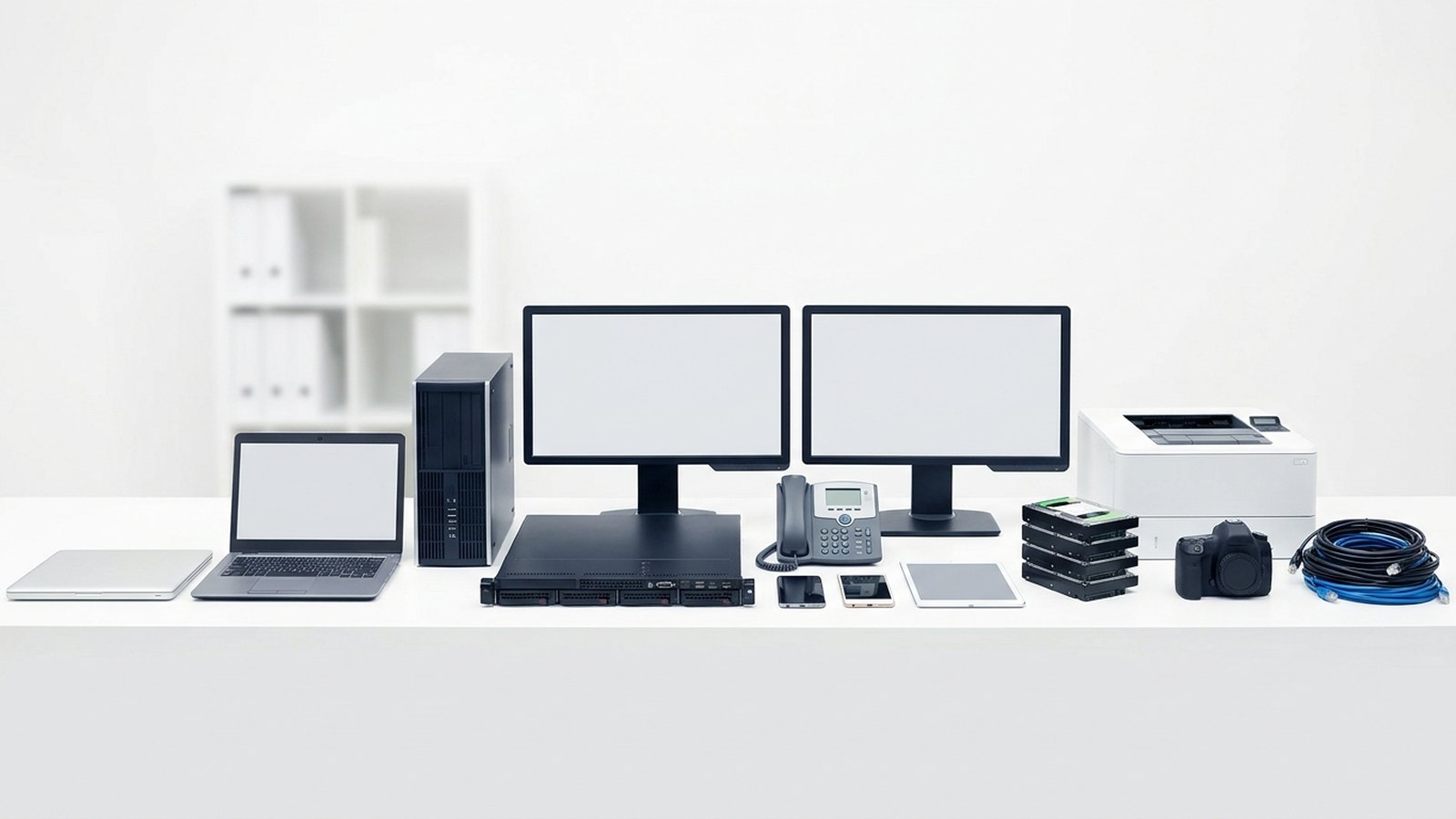
The range of business IT we collect: laptops, desktop tower, server, monitors, desk phone, mobiles, tablet, hard drives, printer, camera and cables

How it works

1

Book a collection

Tell us roughly what you have.

2

We collect & log

We pick up and record every asset.

3

Certified data wipe

Secure destruction + a certificate.

4

Refurbish & rehome

Reuse what we can, recycle the rest.

5

Your impact report

Proof of where it all went.

Refurbished laptops boxed and ready to be given to digitally-excluded Londoners

Where your old kit ends up

Every device that still has life in it is wiped, refurbished and tested, then given free to a Londoner who can't afford one — through our network of partner charities, schools and community organisations.

Nothing is resold for profit. Whatever can't be reused is recycled responsibly through licensed WEEE channels, and you get the paperwork that proves it.

See our impact

Our impact so far

0
Devices rehomed
0
People connected
0
E-waste diverted
0
CO₂ saved

Launching 2026 — numbers update as we grow.

Frequently asked questions

A linear economy follows a "take, make, waste" model where resources are extracted, products are made and used, then discarded. A circular economy keeps products and materials in use for as long as possible through reuse, repair, and recovery, closing the loop rather than breaking it.

The circular economy is significantly better for the environment. It reduces demand for raw material extraction, cuts manufacturing emissions, and diverts waste from landfill. For IT equipment specifically, reusing a device avoids the substantial embodied carbon of manufacturing a new one.

Yes. Many circular practices — such as using a certified ITAD provider for responsible IT disposal and choosing refurbished devices for procurement — require no capital investment and can reduce costs. The main requirement is a policy decision and a reliable partner.

The UK government has committed to circular economy principles through the Environment Act 2021, Extended Producer Responsibility regulations, and the Resources and Waste Strategy. Regulatory pressure on businesses to reduce waste and report on resource use is increasing year on year.

Certified ITAD providers handle data destruction as a core part of the refurbishment process. Devices are wiped to recognised standards — such as those published by the National Cyber Security Centre — before being refurbished or recycled. A certificate of data destruction is issued for every asset processed.

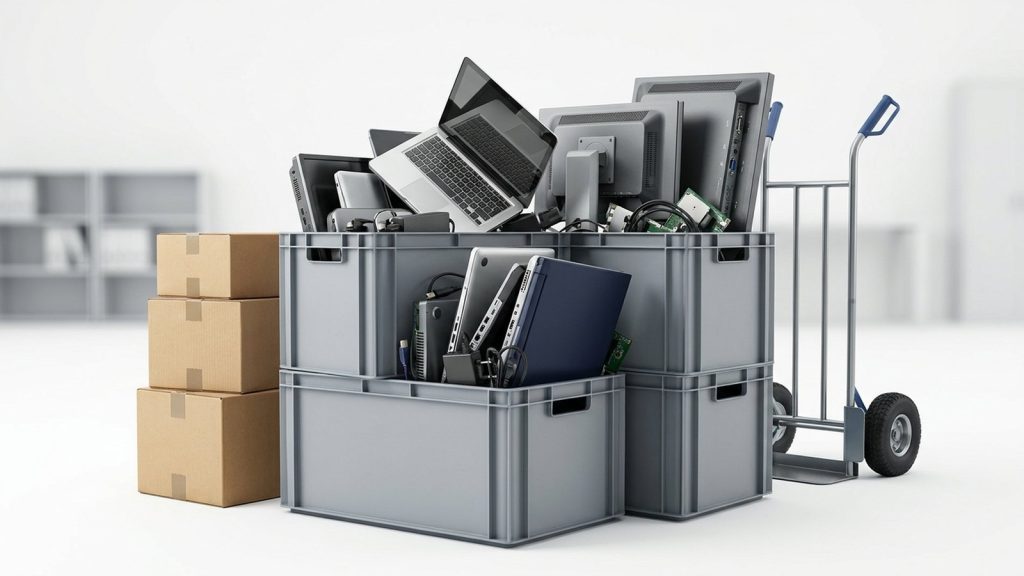
Crates and boxes of office IT equipment stacked with a sack trolley, staged for collection

Upgrading your office IT?

Turn your old kit into compliance, ESG impact and digital opportunity for someone who needs it.

Book a free collection

What is a linear economy?

The linear economy is the dominant model of the 20th century and, in most sectors, still the default today. Raw materials are extracted from the earth, manufactured into products, sold to consumers or businesses, used for a period, and then discarded. In economic terms, it is sometimes called the “take, make, waste” model.

For IT equipment, this plays out in a familiar cycle. A business buys new laptops. After three or four years, they are retired — sometimes because they have stopped working, more often because they feel slow compared to newer models. They go into a skip, a general waste stream, or — at best — a recycling bin that may or may not handle them correctly. The materials inside them are largely lost.

This model worked tolerably well when populations were smaller, materials were cheap, and the consequences of waste were less visible. None of those conditions hold today.

What is a circular economy?

A circular economy is designed to keep products, components, and materials in use for as long as possible, recovering value at every stage rather than discarding it. The Ellen MacArthur Foundation, which has led global circular economy thinking since 2010, describes it as a system that “decouples economic activity from the consumption of finite resources.”

In the circular model, the end of one product’s life is the beginning of another’s. A retired laptop can be refurbished and given to someone who needs it. If refurbishment is not possible, components can be harvested for repair of other devices. If components cannot be reused, materials can be recovered through certified recycling. At no stage does the device simply disappear into a waste stream.

Circular vs linear economy: a comparison

Dimension Linear economy Circular economy
Core logic Take, make, waste Reduce, reuse, recycle
Resource use Extract continuously Recover and recirculate
Product design Optimised for manufacture Optimised for longevity and disassembly
End of life Disposal Recovery and re-entry
Value model New = better Extended life = value
Environmental impact High and cumulative Reduced through closed loops
IT example Buy new laptop; skip old one Refurbish; donate; recycle certified
Business risk Supply chain volatility; regulatory exposure Greater resilience; ESG credentials

Why does the distinction matter for IT?

Electronics are among the most resource-intensive products made. A single laptop requires approximately 800 kg of raw materials to manufacture, including metals mined from some of the world’s most ecologically sensitive regions. The carbon emissions embedded in manufacturing a new device typically dwarf the emissions from using it over its operational life.

Yet the linear model encourages businesses to retire devices on a fixed schedule — often driven by manufacturer warranty cycles rather than actual device condition. Devices that still function are discarded because the administrative convenience of buying new outweighs the perceived value of extending existing ones.

The circular model challenges this. It asks: is this device genuinely at end of life, or is it simply at the end of a contract? Can it be refurbished for another three years? Can it serve another user — perhaps in a school, a charity, or a community organisation — at no cost to them?

How does Recycle4Charity apply circular thinking to IT?

Our model is built explicitly on the circular principle that reuse is preferable to recycling, and recycling is preferable to disposal.

When a London business retires a batch of laptops, desktops, or mobile devices and sends them to us, every device is assessed individually. Those that are functional — or can be repaired — are wiped securely, refurbished, and donated free of charge to digitally excluded Londoners. Those that cannot be refurbished are processed by certified WEEE recyclers who recover metals and materials rather than sending them to landfill.

The result is a measurable circular outcome: fewer new devices needed, fewer raw materials extracted, fewer emissions from manufacturing, and real technology access for people who would otherwise go without.

This is the practical difference between the linear and circular model in action. The linear approach says: buy new, dispose of old. The circular approach says: extend life, recover value, share access.

What are the barriers to circularity in IT?

Shifting from a linear to a circular approach is not without friction.

Data security concerns are the most common objection. Businesses worry that refurbished devices might retain sensitive data. Certified ITAD providers address this through documented data destruction processes — including software wiping to NCSC-approved standards and physical destruction where required — and issue certificates of data destruction for every asset.

Administrative complexity can deter businesses from engaging with refurbishment programmes. A good ITAD partner removes this barrier with collection logistics, asset tracking, and documentation handled end to end.

Procurement habits are harder to shift. Many organisations default to buying new because the process is familiar and the approval pathway is established. Circular procurement — buying refurbished, specifying longevity in contracts, planning for device recovery — requires a deliberate policy decision.

Each of these barriers is surmountable. The regulatory direction of travel — including the UK’s Environmental Reporting Guidelines and the growing prominence of ESG disclosure — is pushing businesses towards the circular model whether they are ready or not.

Explore the social and environmental impact of circular IT at Recycle4Charity, or read about what the circular economy means in practical terms for organisations managing IT assets.


Moving from linear to circular IT disposal starts with one conversation. Get in touch to arrange a collection and find out what your old devices can do next.

Where do the circular economy principles come from?

The Ellen MacArthur Foundation, established in 2010, is the most influential organisation advancing circular economy thinking globally. Its three core principles provide a practical framework for redesigning economic systems — not just improving them at the margins.

These principles are not abstract ideals. Each one has direct implications for how businesses design products, manage supply chains, handle waste, and report on environmental performance. For the IT sector specifically, they offer a clear blueprint for doing better.

Principle 1: Eliminate waste and pollution

The first principle holds that waste and pollution are not inevitable by-products of economic activity — they are the result of poor design choices.

In a conventional economy, a laptop is designed to be manufactured, sold, used for a few years, and discarded. The materials inside it — aluminium, copper, gold, rare earth elements — are extracted once, used once, and then largely lost. This is waste by design.

The circular alternative starts at the beginning: design products to last longer, be repaired more easily, and be disassembled at end of life so their materials can be recovered efficiently. Modular smartphones, such as those made by Fairphone, are a direct application of this principle. Their components can be replaced individually rather than rendering the entire device obsolete when one part fails.

For businesses disposing of IT equipment, this principle translates into a practical question: are you choosing a disposal route that recovers maximum value, or one that simply removes the inconvenience? Sending devices to a certified ITAD provider — rather than general waste — is the difference between elimination and contribution to the problem.

Principle 2: Circulate products and materials at their highest value

This is the principle that most people associate with the circular economy, and it is the one with the most immediate relevance to IT disposal.

“Highest value” is the key phrase. A working laptop has more value as a laptop than as a collection of metal and plastic. A working hard drive has more value as a storage device than as a source of recovered aluminium. The circular economy prioritises keeping things at their highest level of value for as long as possible.

The Ellen MacArthur Foundation describes two distinct cycles here:

The technical cycle covers products made from non-biological materials — electronics, plastics, metals. In this cycle, the preferred order is:
1. Maintain and extend product life
2. Reuse the whole product
3. Refurbish and redistribute
4. Remanufacture components
5. Recycle materials as a last resort

The biological cycle covers organic materials — food, cotton, wood — that can safely re-enter natural systems through composting or anaerobic digestion.

For IT equipment, the technical cycle is what matters. At Recycle4Charity, we apply this hierarchy directly. Every device collected from a London business is assessed. If it works, or can be made to work, it is refurbished and donated — keeping it circulating as a device rather than reducing it to raw materials. Only when refurbishment is not possible do we move to recycling through certified WEEE partners.

This is also the principle that makes IT reuse a stronger environmental choice than IT recycling. Recycling recovers materials but destroys the embodied value of the device. Reuse preserves it.

Principle 3: Regenerate natural systems

The third principle extends beyond products and materials to consider the broader impact on natural systems.

For biological materials, this means returning nutrients to the soil rather than losing them to landfill or incineration. For the technology sector, the connection is less direct but still meaningful. Every device that is reused rather than discarded reduces demand for new manufacturing. Less manufacturing means less mining, less energy consumption, less habitat disruption, and fewer carbon emissions.

The extraction of materials used in electronics — including cobalt, lithium, tin, and rare earth elements — has significant environmental and human costs. Mines in the Democratic Republic of Congo, Chile, and Indonesia supply materials that end up in devices used globally. Extending device life through reuse and refurbishment directly reduces the pressure on those extraction systems.

Regenerating natural systems also means choosing suppliers and partners who operate responsibly. Certified ITAD providers, like Recycle4Charity, process equipment in controlled environments rather than exporting it to informal recycling markets, where inadequate handling causes serious pollution and harm to workers and communities.

How do these principles apply together?

The three principles work as a system, not a checklist. Eliminating waste requires designing for circulation. Circulating at highest value requires not contaminating or destroying materials unnecessarily. And regenerating natural systems requires both of the first two, applied consistently.

For an IT director or sustainability manager reviewing their organisation’s asset disposal process, the principles translate into practical questions:

  • Are we choosing a disposal partner who prioritises reuse before recycling?
  • Are we documenting the outcome — devices donated, materials recovered, waste diverted — to support our ESG reporting?
  • Are we applying circular thinking at the procurement stage, not just at disposal?

These are not rhetorical questions. Each one has a measurable answer, and increasingly, investors, clients, and regulators want to see that answer.

To understand the social and environmental impact of circular IT practices, explore our impact data. For businesses managing IT asset disposal, our WEEE recycling and ITAD services are built around these three principles from the ground up.


Putting circular economy principles into practice starts with a single decision: what happens to your old IT equipment. Contact our team to find out how we can help.

Why look at tech for circular economy examples?

Technology is both one of the most resource-intensive industries on the planet and one of the most promising candidates for circular transformation. Electronics contain dozens of valuable materials — gold, copper, cobalt, lithium, rare earth elements — that are expensive to extract, geopolitically sensitive to source, and frequently lost when devices are discarded.

At the same time, the tech sector has characteristics that make circularity achievable: global supply chains capable of reverse logistics, established repair ecosystems, and a growing market for refurbished devices. The examples below illustrate what circularity looks like at different scales and in different contexts.

Example 1: Modular design — Fairphone

Fairphone, a Dutch electronics manufacturer, has built its entire product line around the principle of repairability. Its smartphones are designed so that users — not just technicians — can replace the battery, screen, camera, and other components without specialist tools.

This is circular design applied at the product level. Rather than engineering a device that becomes obsolete when one part fails, Fairphone engineers for longevity. Spare parts are sold directly to consumers. The company also publishes repairability scores and sustainability reports.

The result is a device with a significantly longer usable life than a conventional smartphone. The Ellen MacArthur Foundation has cited modular design as one of the clearest examples of circular economy principles applied in the technical cycle.

Fairphone is a small manufacturer, but its model demonstrates what is possible when the principles of circular economy shape the design brief from the outset.

Example 2: Manufacturer take-back schemes

Several major technology manufacturers have introduced take-back or trade-in programmes as a response to growing regulatory and consumer pressure. Apple, Dell, HP, and Lenovo all operate schemes that allow customers to return old devices.

These programmes vary significantly in quality. Some genuinely prioritise refurbishment and resale — keeping devices in use as devices rather than breaking them down for materials. Others primarily serve as a disposal channel, with recycling (rather than reuse) as the primary outcome.

The value of take-back schemes depends entirely on what happens to devices after collection. A scheme that refurbishes 80% of returned devices and recycles 20% is doing very different work from one that recycles all returns. Businesses evaluating manufacturer take-back options should ask for data on refurbishment rates, not just “recycling” rates.

The UK’s Waste Electrical and Electronic Equipment (WEEE) Regulations place obligations on producers to fund the collection and treatment of waste electronics. Take-back schemes are one mechanism through which manufacturers meet those obligations.

Example 3: The refurbished device market

The global market for refurbished smartphones and laptops has grown substantially in recent years. Refurbished devices are pre-owned products that have been inspected, cleaned, repaired where necessary, and certified to a performance standard before resale.

For consumers and organisations buying refurbished, the appeal is clear: lower price, equivalent function. For the circular economy, the appeal is equally clear: a refurbished device is a device kept in use rather than one prematurely discarded.

The refurbished market operates across multiple channels — manufacturer-certified programmes, specialist retailers, and social enterprises. Quality standards vary, so buyers should look for graded, tested devices with documented refurbishment processes.

Example 4: Corporate IT refurbishment and donation — the Recycle4Charity model

Recycle4Charity operates a model that demonstrates what circular IT looks like in a London business context.

When an organisation retires its IT equipment — laptops, desktops, monitors, tablets, phones — we collect it, handle secure data destruction, and assess every device. Those that are functional are refurbished and donated free of charge to digitally excluded Londoners, through partnerships with schools, charities, and community organisations across the city.

This is a circular model with a social dimension. The business gets certified data destruction, documented asset disposal, and the ability to report on devices donated and waste diverted. The recipient gets technology they could not otherwise afford. The device gets a second life rather than a premature end.

For businesses with ESG reporting obligations, this kind of circular outcome — devices reused, waste diverted, social impact created — is precisely what sustainability disclosures are meant to reflect. Our impact page shows the numbers behind our work.

Where devices cannot be refurbished, we work with certified WEEE recycling partners. Nothing goes to landfill. This reflects the priority order of the waste hierarchy: reuse first, then recycle, never dispose.

Example 5: Leasing and product-as-a-service models

Some technology companies have moved away from selling devices altogether, instead offering them on a subscription or lease basis. Under this model, the manufacturer retains ownership of the device throughout its life and takes it back at the end of the contract for refurbishment or recycling.

This “product as a service” approach aligns the manufacturer’s incentives with device longevity: if they own the device, they have a financial reason to make it last as long as possible.

Examples include managed device programmes from major manufacturers and specialist leasing companies. The model is growing in the enterprise IT sector, where predictable monthly costs and guaranteed replacement cycles are attractive to finance teams.

What do these examples have in common?

Each of these circular economy examples in tech shares a common logic: treat the device as an asset rather than a consumable. Design it to last. Plan for its recovery. Make reuse the preferred outcome over recycling, and recycling the preferred outcome over disposal.

For most organisations, the most accessible starting point is not product design or take-back scheme management — it is the decision of what to do when devices are retired. Choosing a certified ITAD partner who prioritises refurbishment and donation is the single most impactful circular action available to the average London business.

Read more about the principles that underpin the circular economy or explore our business IT disposal and WEEE recycling services.


Ready to make your next IT refresh a circular one? Get in touch with Recycle4Charity and we’ll handle the rest.

Why a certificate of data destruction matters

UK GDPR does not simply require organisations to destroy personal data — it requires them to be able to demonstrate that they did so. Article 5(2), the accountability principle, places the burden of proof on the data controller. When the Information Commissioner’s Office (ICO) investigates a data breach or a complaint about improper disposal, it will ask what evidence the organisation holds to show that data was destroyed correctly.

A certificate of data destruction is that evidence. Without one, an organisation is in the position of asserting compliance without being able to prove it. With one, it can point to a specific document recording the device, the method, the date, and the party responsible.

The certificate also protects the organisation in other scenarios: when demonstrating compliance to clients or auditors, when responding to a subject access request that asks whether data has been deleted, and when managing claims arising from a data incident.

What should a certificate of data destruction contain?

A well-formed certificate of data destruction should include all of the following:

  • Name and contact details of the provider: The organisation that carried out the destruction, including their registered address and any certification numbers relevant to their accreditation.
  • Name and address of the client: The organisation that commissioned the destruction — your business.
  • Date of destruction: The date on which destruction was completed, not the date of collection.
  • Device identifiers: For each device destroyed, the make, model, and serial number (or asset tag if the serial number is unreadable). Batch certificates should list all devices or reference a separate schedule.
  • Destruction method: Whether the data was destroyed by software overwriting, degaussing, or physical shredding.
  • Standard applied: The specific standard the destruction was carried out to — for example, NIST Special Publication 800-88 for software wiping, or the relevant NCSC/HMG IA Policy No.5 particle size for physical shredding.
  • Verification statement: Confirmation that the destruction was verified — for software wiping, this means a verification pass; for physical shredding, a chain-of-custody record and witnessed destruction or equivalent.
  • WEEE disposal confirmation: A statement confirming that residual material was recycled in compliance with the WEEE Regulations 2013 through an authorised treatment facility.
  • Signature and authorisation: The certificate should be signed by an authorised representative of the provider.

Some certificates also include a unique certificate reference number, which allows the document to be cross-referenced against the provider’s internal records if questions arise later.

What a certificate of data destruction does not cover

A certificate is only as reliable as the process behind it. A document that lists devices and claims destruction occurred is not meaningful unless the provider can demonstrate:

  • That the devices listed were in their custody
  • That the destruction method described was actually applied
  • That verification occurred (for wiping) or that the chain of custody is unbroken (for shredding)

When selecting a provider, ask how they record device identifiers before destruction, how they verify the process, and whether they can provide evidence to support the certificate if it is ever challenged.

How long should you keep a certificate?

UK GDPR does not specify a retention period for compliance documents. As a general principle, certificates should be kept for as long as the personal data they relate to would have been retained — and for any period during which a regulatory or legal challenge to the disposal could arise. In practice, many organisations retain destruction certificates for a minimum of five to seven years.

Store certificates alongside your IT asset register and your data retention policy so that the full lifecycle of each device — from procurement to destruction — can be traced if needed.

Template: key fields to include

If your organisation carries out in-house data destruction and needs to create its own certificate, the document should capture all the fields listed above. A simple template structure might look like this:

Certificate of Data Destruction

Field Value
Certificate reference [unique number]
Issuing organisation [name, address, contact]
Client organisation [name, address]
Collection date [date]
Destruction date [date]
Destruction method [wiping / degaussing / shredding]
Standard applied [e.g. NIST SP 800-88 / NCSC guidance]
WEEE disposal [confirmed / provider name]
Authorised signatory [name, title, signature]

A separate schedule attached to the certificate should list every device by make, model, serial number, and the individual verification result (for wiping) or confirmation of inclusion in the shredded batch.

Recycle4Charity’s approach

Recycle4Charity issues a certificate of data destruction with every collection. The certificate records each device individually, specifies the destruction method and the standard applied, and confirms WEEE-compliant recycling of residual material. Devices that pass certified wiping and a hardware quality check are refurbished and donated free to digitally-excluded Londoners — so your compliance documentation comes with a social benefit.

For an overview of the data destruction methods we use, see our guide to what is secure data destruction. To arrange a collection and receive your certificate, visit our data destruction for business page.

What determines how long a business laptop lasts?

Business laptops are built to a higher standard than consumer models, but they still have finite working lives. Several factors determine where in the three-to-five-year window a specific device falls.

Manufacturer support is often the defining constraint. When a laptop model reaches end of support, the manufacturer stops issuing firmware updates and the operating system vendor may stop issuing security patches. Running unsupported hardware is a security risk that most IT teams cannot accept, regardless of whether the device still functions.

Battery degradation affects usability rather than function. Most lithium-ion laptop batteries retain reasonable capacity for two to three years of full-time use, after which charge duration drops noticeably. A laptop tethered permanently to a power cable is a mobility asset that has lost its main advantage.

Component performance relative to software requirements changes over time. A laptop that handled business applications well in year one may struggle by year four as software updates, browser engines, and collaboration tools grow more demanding.

Physical wear — keyboard failures, hinge damage, worn trackpads — tends to accumulate in year four and beyond, particularly on devices used intensively or transported frequently.

What are the signs a business laptop should be replaced?

Performance has degraded noticeably

Slow boot times, frequent freezes, and applications taking longer to load than on comparable newer devices are indicators that hardware is no longer keeping pace with software demands. Before assuming replacement is needed, rule out software causes — malware, accumulated startup items, or a failing hard drive can mimic age-related slowdown. If a clean install does not resolve the issue, hardware is likely the constraint.

The battery no longer supports a working day

Most organisations expect a laptop to support a full working day away from a power source. When battery life drops below four hours under typical use, productivity suffers. Battery replacement is possible and sometimes economical, but on older models the labour cost plus the cost of a compatible battery may approach the residual value of the device.

Manufacturer support has ended

Check the manufacturer’s support lifecycle for each model in your fleet. Microsoft, Lenovo, HP, Dell, and Apple all publish end-of-support dates. A device that no longer receives security patches is a liability regardless of physical condition. This is the point at which even well-functioning hardware should be considered for retirement.

Repair costs exceed residual value

The general rule is that a single repair costing more than 50% of the device’s current replacement cost signals it is time to retire. Track repair history by serial number — devices that have required multiple repairs in their fourth or fifth year are poor candidates for continued service.

The device cannot run your standard image

If a planned operating system upgrade or enterprise software deployment requires hardware that a laptop cannot meet — RAM thresholds, TPM version, storage capacity — that device will need to be excluded from your standard environment. Managing a split fleet with different software configurations adds administrative overhead that often outweighs the cost of refreshing.

How do refresh cycles affect disposal planning?

Most IT managers plan laptop refreshes on a rolling basis — replacing a proportion of the fleet each year to avoid a large capital outlay in a single budget period. A three-year rolling refresh means roughly one third of devices are retired annually. A four-year cycle means one quarter.

Planning the disposal of outgoing devices at the same time as planning the refresh is good practice. It avoids a situation where retired hardware accumulates in a store cupboard with data still present on drives.

Our IT refresh cycle guide goes into more detail on planning refresh schedules and how to align disposal with procurement.

What happens to retired laptops?

Laptops that are three to four years old and still functional often have useful life remaining. Recycle4Charity assesses each device and, where it meets our criteria, donates it free of charge to digitally excluded Londoners. A laptop that is no longer suitable for your corporate environment can still make a real difference for someone who has none.

Devices that do not qualify for reuse are recycled through a certified process. Data destruction is completed first, followed by disassembly and materials recovery. You receive documentation for every device. Read our full guide to laptop recycling for businesses for details on what the process involves.

Why Should Businesses Care About Digital Inclusion?

Digital exclusion costs the UK economy significantly — in lost productivity, higher public service demand, and constrained consumer markets. But for businesses, the case for action goes beyond the macro picture.

ESG and social value reporting: UK businesses bidding for public contracts are increasingly required to demonstrate social value under the Public Services (Social Value) Act 2012. Digital inclusion activities — device donation, skills volunteering, community partnerships — generate quantifiable social value outputs that count in procurement scoring.

Stakeholder expectations: Employees, investors, and customers increasingly expect businesses to account for their social and environmental impact. A structured digital inclusion programme, reported with clear metrics, signals genuine commitment rather than token gesture.

Supply chain and workforce considerations: Businesses that depend on digitally skilled workers have a direct interest in expanding the pipeline of digitally capable people. Supporting digital inclusion in local communities is one way to contribute to this.

Responsible asset disposal: Businesses replace IT equipment on a regular cycle — typically every three to five years. Without a structured disposal process, devices end up in storage rooms, are disposed of without data wiping, or go to landfill. A partnership with an organisation like Recycle4Charity turns this liability into a social asset, with a certified data destruction audit trail.

What Can Businesses Do?

Option 1: Donate End-of-Life IT Equipment

This is the highest-impact, lowest-effort option for most businesses. Every laptop, desktop, tablet, or smartphone that comes off your IT asset register can be collected by Recycle4Charity, data-wiped to a certified standard, refurbished, and distributed to a digitally-excluded Londoner — free of charge to you.

What Recycle4Charity provides:
– Free collection from your London premises
– Certified data destruction to ADISA standards
– Individual certificate of data destruction per device (for GDPR audit trail)
– Aggregated impact report showing devices received and distributed
– Zero-landfill commitment — non-refurbishable devices go to certified WEEE recycling

This is directly relevant to your GDPR obligations. The ICO expects businesses to ensure data is securely destroyed when IT assets are disposed of. An ADISA-certified wipe with a certificate of destruction satisfies this requirement.

Find out more on our partners page.

Option 2: Become a Corporate Partner

Beyond one-off device donations, Recycle4Charity works with corporate partners on a more structured basis. Partnership options include:

  • Regular collection schedules aligned to your IT refresh cycle
  • Joint communications — co-branded impact reports, internal communications, and social content
  • Named partnership — acknowledged on our website and in impact reports
  • Matched giving — some partners fund additional refurbishment capacity, enabling devices to reach more recipients

Corporate partnerships work well for organisations with significant IT estates, regular refresh cycles, or CSR teams looking for a clear, reportable community impact.

Option 3: Employee Volunteering

Employees with digital skills can volunteer as digital champions — supporting digitally-excluded individuals in community settings, helping them learn to use devices, access services, and stay safe online. The Good Things Foundation runs a Digital Champions Network that provides training and resources for volunteers.

This type of volunteering counts as skills-based volunteering in ESG disclosures and tends to be highly rated by employees for personal impact.

Option 4: Payroll Giving and Charitable Funding

If your organisation has a payroll giving scheme or a charitable donations budget, digital inclusion organisations are worthy recipients. Funding from businesses supports infrastructure — refurbishment capacity, device logistics, community partnership management — that enables more devices to reach more people.

How to Report Digital Inclusion in Your ESG Disclosure

UK businesses using recognised ESG frameworks can report digital inclusion activities under Social (S) pillars. Common frameworks and how digital inclusion fits:

Framework Relevant section
GRI Standards GRI 413: Local Communities
UN SDGs SDG 4 (Quality Education), SDG 10 (Reduced Inequalities)
Social Value Act 2012 Theme: Promoting equal opportunities
B Corp Assessment Community pillar
TCFD / ISSB Social and community impacts under governance

When reporting, include:
– Number of devices donated
– Data destruction certificates issued (demonstrates GDPR compliance)
– Number of beneficiaries reached (Recycle4Charity can provide this)
– Employee volunteering hours in digital inclusion activities
– Monetary equivalent of in-kind donation (market value of devices at time of donation)

Which Businesses Are Best Placed to Contribute?

Any business that uses computers, laptops, tablets, or phones is a potential donor. Organisations with particularly high volumes of equipment turnover include:

  • Financial services (banks, insurers, asset managers)
  • Law firms
  • Accountancy and professional services
  • Technology companies
  • NHS trusts and healthcare organisations
  • Universities and colleges
  • Retailers with large head-office operations
  • Local authorities and government departments

London-based businesses are especially well positioned to work with Recycle4Charity, as we focus our distribution on digitally-excluded Londoners. The connection between donor and beneficiary is direct and local.

Read more about what happens to donated devices on our donated devices impact page, or contact us via our partners page to discuss how your business can get involved.

What is IT asset tracking in the context of disposal?

IT asset tracking means maintaining a documented record of each device — identified by its serial number or asset tag — through every stage of the disposal process. From the moment a device is logged for retirement to the moment a destruction or recycling certificate is issued, each transfer and action is recorded and attributable.

This is distinct from asset tracking during active use, where the goal is inventory management. During disposal, the goal is chain of custody: a continuous, auditable record that demonstrates no unauthorised access, loss, or data breach occurred between the device leaving your organisation and its storage being verified as destroyed.

Why does chain of custody matter under UK GDPR?

The UK General Data Protection Regulation (UK GDPR), implemented through the Data Protection Act 2018, requires data controllers to implement appropriate measures to ensure personal data is protected. The accountability principle — Article 5(2) — requires organisations not just to comply, but to be able to demonstrate compliance.

When the ICO investigates a data breach, one of the first questions is: what happened to the device that held the data? If the answer is “we handed it to a recycler but have no documentation”, the organisation has a problem. A complete chain of custody — from internal retirement log to data destruction certificate — is the evidence that demonstrates control was maintained.

The ICO has issued fines and enforcement notices against organisations that failed to document data destruction adequately. Chain of custody documentation is not optional.

What does good IT asset tracking look like during disposal?

A robust tracking process includes:

Pre-collection manifest — before any device leaves your premises, it is logged. The manifest records: serial number, make, model, asset tag (if applicable), location, assigned user, and the data classification of information previously held on the device. This manifest is signed off by an authorised internal contact.

Collection receipt — at the point of collection, the ITAD provider issues a signed receipt confirming which assets they have taken into custody. The receipt cross-references the manifest. Any discrepancies — a device on the manifest that is not present, or a device present that is not on the manifest — are flagged and resolved before the collection team leaves.

Transfer of custody documentation — the WEEE Regulations 2013 require a waste transfer note when electrical equipment is transferred to an authorised treatment facility. This note identifies the transferor (your organisation), the transferee (the ITAD provider), the date, and the type and quantity of equipment. Retain this note.

Data destruction certificates — a certificate is issued for every device that contains or may contain storage media. Each certificate cites the specific device (by serial number or IMEI), the destruction method used, the standard to which it was performed, the date, and the name of the technician. Certificates should be received per device, not per batch.

Asset disposition report — after processing, you receive a report mapping every serial number on the original manifest to its outcome: data-wiped and refurbished, data-wiped and resold, data-wiped and recycled, or destroyed. This is your end-to-end record.

What should each certificate contain?

A data destruction certificate that will stand up to ICO scrutiny should include:

  • Your organisation’s name and site address
  • The ITAD provider’s name, registered address, and authorised treatment facility registration number
  • Device serial number (or IMEI for mobile devices)
  • Make and model
  • Storage type and capacity (where known)
  • Data destruction method (overwrite, degauss, shred)
  • Standard applied (HMG IS5, NIST 800-88, or equivalent)
  • Date of destruction
  • Technician name or identifier
  • Provider’s authorised signature or stamp

Certificates that list only “batch X, 50 devices, wiped” without individual serial numbers do not provide adequate evidence for UK GDPR accountability.

How does asset tracking support WEEE compliance?

The WEEE Regulations 2013 require business waste producers to transfer electrical and electronic equipment waste to an authorised treatment facility and to retain documentation of that transfer. The waste transfer note is the primary document.

Beyond the transfer note, WEEE compliance depends on being able to demonstrate that equipment classified as waste was treated by a licensed facility and that any hazardous components were handled appropriately. An asset disposition report that shows each device was processed — not just collected — provides that evidence.

Integrating disposal tracking with your asset register

Many organisations maintain an asset register or configuration management database (CMDB) throughout a device’s active life. Disposal tracking closes the loop: when a device is retired and disposal is complete, its serial number should be updated in the register with a status of “disposed”, the disposal date, the ITAD provider, and a reference to the data destruction certificate.

This integration prevents the common problem of “ghost assets” — devices that appear active in the register but are physically absent. Ghost assets create audit risk and can obscure genuine losses.

Our IT asset disposal service includes a full asset disposition report on every collection, designed to map directly to your internal asset register. For more detail on how we handle the full disposal chain, read our overview of what ITAD involves.