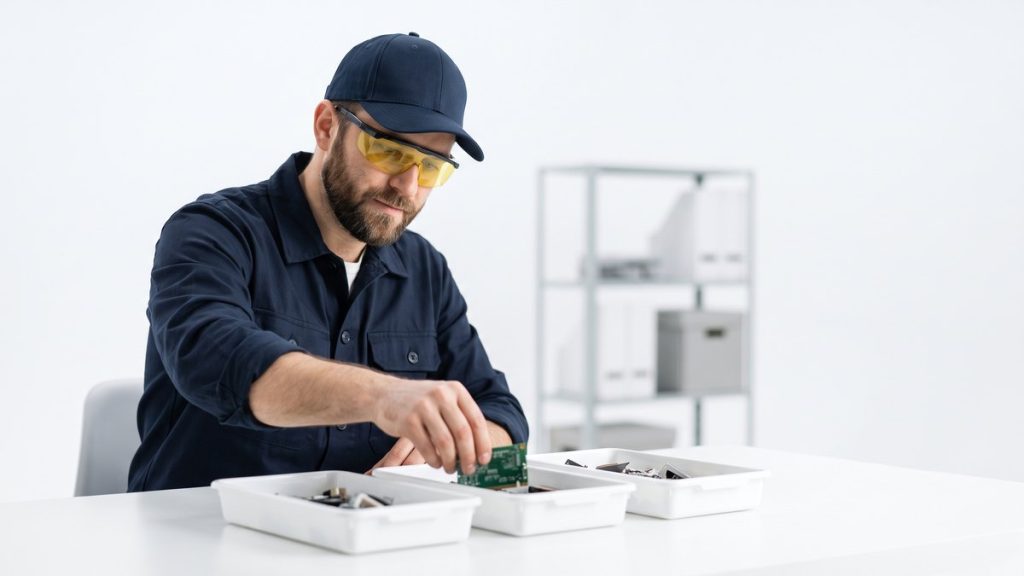
What Makes E-Waste Recycling Different?
Recycling e-waste is not the same as putting cardboard in a blue bin. Electrical and electronic equipment contains a complex mixture of materials — valuable metals, hazardous substances, and data-bearing components — that each require specialist handling. A responsible recycling process addresses three distinct problems simultaneously: environmental compliance, resource recovery, and data security.
Under the WEEE Regulations 2013 (SI 2013/3113), UK businesses are legally required to follow a defined disposal chain. Getting it right protects the environment, protects your business from enforcement action, and — if you choose a social enterprise provider — can support people in your community.
Step 1: Apply the Waste Hierarchy
Before arranging recycling, apply the waste hierarchy — a principle embedded in UK waste law that requires waste prevention to be prioritised above all other options, with recycling preferred over disposal.
In practice, this means:
- Can the equipment be repaired? A faulty device that costs less to fix than replace should be repaired
- Can it be reused? Working IT equipment — laptops, desktops, monitors, tablets — can be refurbished and donated or sold rather than recycled
- Can parts be harvested? Some items can be cannibalised for components before the remainder is recycled
Only equipment that genuinely cannot be reused or repaired should enter the recycling stream. Organisations like Recycle4Charity accept working IT equipment from London businesses and donate refurbished devices to digitally excluded residents — keeping kit in use and out of the waste stream.
Step 2: Audit What You Have
Before arranging a collection, create a list of equipment due for disposal. For each item, note:
- Device type (laptop, desktop, server, monitor, printer, phone, etc.)
- Serial number (useful for data destruction records and certificate matching)
- Whether it contains a hard drive, SSD, or other data storage
- Whether it contains a battery (which must be removed and separately treated)
- Whether it is a CRT device or contains mercury (hazardous WEEE — additional documentation required)
This audit supports both compliance documentation and data destruction planning.
Step 3: Choose a Responsible Recycler
Not all recycling contractors are equal. When selecting a provider, verify the following:
| Check | What to ask | Where to verify |
|---|---|---|
| Waste carrier licence | Registration number and expiry date | Environment Agency public register on gov.uk |
| AATF permit | Facility name and permit number | Environment Agency public register on gov.uk |
| Data destruction capability | Method used, standards followed (e.g. NIST SP 800-88, HMG Infosec Standard 5) | Ask for a sample certificate |
| Evidence of downstream recycling | Where materials go after de-pollution | Ask for their material flow documentation |
| Social or environmental accreditations | ISO 14001, ISO 27001, Cyber Essentials, or similar | Ask for certificates |
Avoid contractors who offer significantly below-market pricing with no documentation — this is a warning sign that WEEE may be exported improperly or processed at unlicensed facilities.
Step 4: Arrange Secure Data Destruction
If any equipment contains personal data or commercially sensitive information, data must be destroyed before or at the point of disposal. This is a requirement under UK GDPR and the Data Protection Act 2018, separate from your WEEE obligations.
The two main methods are:
Software-based overwrite: data is overwritten using a method that meets a recognised standard (NIST SP 800-88 or HMG Infosec Standard 5). Suitable for functioning hard drives and SSDs. Produces a per-device audit trail.
Physical destruction: drives are shredded or crushed to render them unreadable. Suitable for faulty drives or where software erasure is not practicable. Produces a destruction certificate.
Request a certificate of data destruction specifying the method, standard, serial numbers, and date. This is your primary evidence of compliance in the event of a data breach or ICO investigation.
For more on this topic, see our guide to what is data destruction and our data destruction service.
Step 5: Complete and Retain Documentation
On collection, your waste carrier must provide:
- A waste transfer note — required for all WEEE collections; retain for at least two years
- A hazardous waste consignment note — required for CRT screens, mercury-containing items, and other hazardous WEEE; retain for three years
- A certificate of data destruction — for all data-bearing devices
Keep these documents in a compliance file. If you are ever audited by the Environment Agency, an insurance provider, or a client procurement team, these records demonstrate that your disposal was lawful.
What Does Recycling Actually Do With the Material?
At a licensed authorised treatment facility, equipment goes through a defined process:
- De-pollution — batteries, mercury lamps, oils, and other hazardous substances are removed by hand before mechanical processing begins
- Dismantling — larger items are broken down; reusable components are extracted
- Shredding — remaining material passes through shredders
- Sorting — metals, plastics, glass, and circuit boards are separated by density and magnetic properties
- Downstream processing — sorted fractions are sent to specialist smelters, plastics recyclers, and glass processors
The recoverable materials from e-waste include copper, aluminium, steel, gold, silver, and palladium. These re-enter the manufacturing supply chain, displacing demand for virgin materials.
Making Your Recycling Count Twice
By choosing Recycle4Charity for your London business’s WEEE disposal, you are doing more than achieving compliance. Equipment that can be refurbished goes directly to Londoners who cannot afford digital devices. Equipment that cannot be reused is processed through our AATF-partnered recycling chain with full documentation.
To arrange a collection, visit our WEEE recycling service for London businesses.